

Kate WhannelPolitical reporter

 Getty Images/ House of Commons
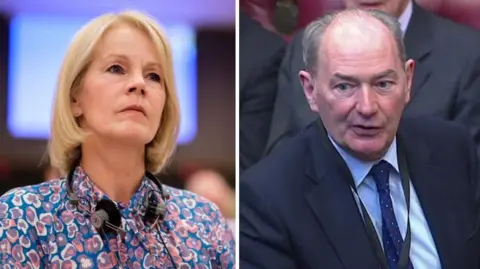
Ex-ballet dancer Baroness Deborah Bull and former Conservative minister Lord Michael Forsyth of Drumlean will compete to be the next Speaker of the House of Lords.
The Lord Speaker chairs debates in the Lords chamber, decides whether ministers should be summoned to answer urgent questions from peers and performs ceremonial roles at events including the State Opening of Parliament.
The race began after Lord John McFall of Alcluith announced he would be stepping down in order to care for his wife who has been diagnosed with Parkinson’s disease.
Peers can vote for the new Speaker from 6 to 8 January, with the winner being announced the following week, subject to the King’s approval.
Baroness Bull was a principal dancer at the Royal Ballet for almost two decades.
Although she danced several leading roles including Odette and Odile in Swan Lake, Baroness Bull said: “If there was a lady of the night, a tart, a harlot or a prostitute to be played, you can bet I was up there doing it.”
After retiring as a dancer, she became a creative director at the Royal Opera House, overseeing smaller, more contemporary productions. She later joined boards at the Southbank Centre, Arts Council England, and the BBC among others.
She also embarked on a broadcasting career, presenting programmes including Dance Night with comedian Alexei Sayle and the radio documentary After I Was Gorgeous, which explored how beauty icons dealt with the ageing process.
In 2013, she told Desert Island Discs: “I always thought I’d feel a passionate sense of loss when I stopped dancing. What was absolutely wonderful was, as the volume turned up on the new career, the volume turned down on the old one.”
In 2018, she joined the House of Lords as a non-party political peer and in 2024 became a deputy speaker.
Her candidacy was supported by Labour peer Baroness Thornton and former national security adviser, Lord Ricketts.
In her candidate’s statement she said: “In complex institutions with long histories, this way of working has defined my career: balancing tradition and innovation, finding consensus, taking difficult decisions and holding fast when required.”
Lord Forsyth is a life-long politician, getting elected to Westminster City Council in 1978 shortly after graduating from the University of St Andrews.
A few years later he became MP for the Stirling constituency, a seat he held until 1997 when his majority got swept away by the Labour landslide.
His constituency was home to the town of Dunblane, site of the massacre, which saw 16 children and their teacher shot and killed at the gym in the local primary school.
Lord Forsyth had known the murderer Thomas Hamilton, who had been a regular visitor to his constituency surgeries.
In an interview with Lord McFall in 2023, he described the event as “the worst thing that has ever happened to me”.
“I still get flashbacks of that scene in the gym, it was just horrendous.”
During his time in the House of Commons he served as a minister in the Home Office and the Department of Employment as well as secretary of state for Scotland between 1995 and 1997.
After losing his seat he was made a Conservative peer in the Lords, where he has chaired a number of committees including the Financial Services Regulation Committee.
He has also sat on the boards of the Royal Society and the National Portrait Gallery and is president of the Steam Boat Association.
His candidacy was supported by former Labour Home Secretary Lord Blunkett and retired senior judge Baroness Butler-Sloss.
Making his election pitch, Lord Forsyth promised “leadership for a more effective, respected and influential House” arguing that “as the Commons continues to struggle to scrutinise legislation effectively, greater pressure will fall on this House”.